The Expanding Learning Horizons (ELH) Conference is over for another year and I am left, once again, feeling lost and flat now that I am back in the real world of work and daily minutiae.  I miss the connection with like-minded educators and the stimulating conversations that accompany such connections.  However, I am also mindful of the need for all of us to keep connecting outside the conference if we truly want to keep expanding our learning horizons.

Expanding and Learning are action words.

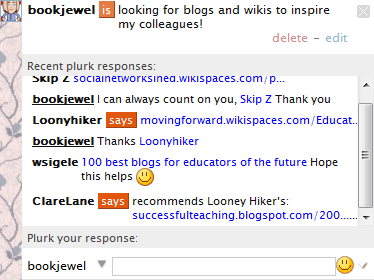
Maintaining an online personal learning network (PLN) is one of the most important professional development activities I undertake in any year.  I can structure a learning path to suit my own context and needs without leaving home.  I can connect with others who share similar contexts and really learn from them.  It takes time but it also saves time.  Imagine how long it would have taken me to find, research and review six quality educator blogs or wikis on my own without the help of my PLN?  Using my connections on Plurk saved me hours.

Using Plurk to find quality blogs and wikis

Using Plurk to find quality blogs and wikis

Exploring and Sharing are ALSO action words

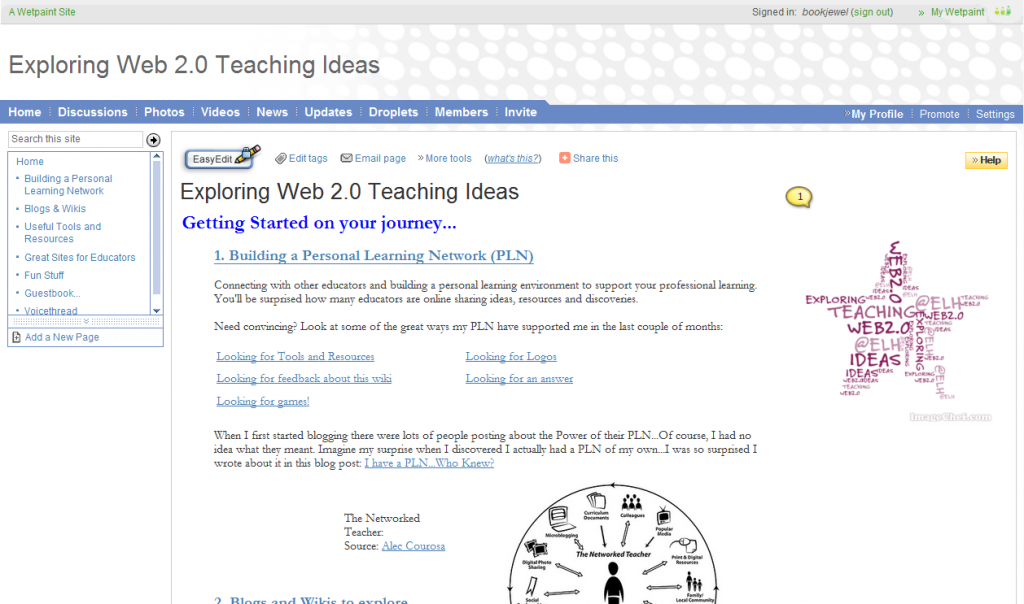
My PLN also supported my ELH Discovery workshop: Exploring Web 2.0 Teaching Ideas by providing feedback on the wiki I designed to support the session.  Many also indicated their intention to share the wiki with colleagues in the U.S.  Hopefully it will continue to be of use to educators for some time.

The networking during ELH took many forms: Twitter (See #ELH09 for our collection of Tweets); Ning; Facebook and various wikis: elhwikimania and my own Exploring Web 2.0 Teaching Ideas.  However, such mediums are only starting points for exploration and expansion of learning horizons.  It is ongoing connection and reflection, educators sharing ideas and learning together, that will make the most difference in the long term.  Maintaining the passion, learning and enthusiasm of ELH will be the real challenge for all of us over the next year!

Exploring Web 2.0 Teaching Ideas

Exploring Web 2.0 Teaching Ideas

Web 2.0 has changed the way we do so many things.

So I wonder if it is possible to sustain a piece of fiction using only Web 2.0 tools…a story told through blogs, wikis and other tools.  Not your usual piece of digital storytelling – I’m thinking major pieces of fiction, possibly serialised, that follow the thoughts and events of characters across a range of formats.  The ‘un-novel’ might use a combination of materials such as youtube clips, blog entries, Nings, podcasts, twitter and the like, to track characters and expose their inner thoughts.

I believe this type of fiction has a lot of potential.  I see teachers of the future introducing Web 2 ‘Story Quests’ or ‘un-novels’ to launch students on a narrative journey with a real difference.  I see students learning to piece together the elements of a narrative from visual, audio and written cues.

I like it.

It could be like a treasure hunt (The ‘treasure’ being the story itself!)

It might even be fun.

There is already a lot of fiction online.  However, it tends to be the same traditional format as offline fiction… youtube instead of movies, and ebooks and ezines instead of books and magazines.  The ‘un-novel’ is different, it crosses several mediums, and with so much happening online these days stories should be different.
Some of the online work that ‘almost’ qualifies as the ‘un-novel’ is listed below but I would love to hear of any others:

•    Inanimate Alice
•    We Tell Stories

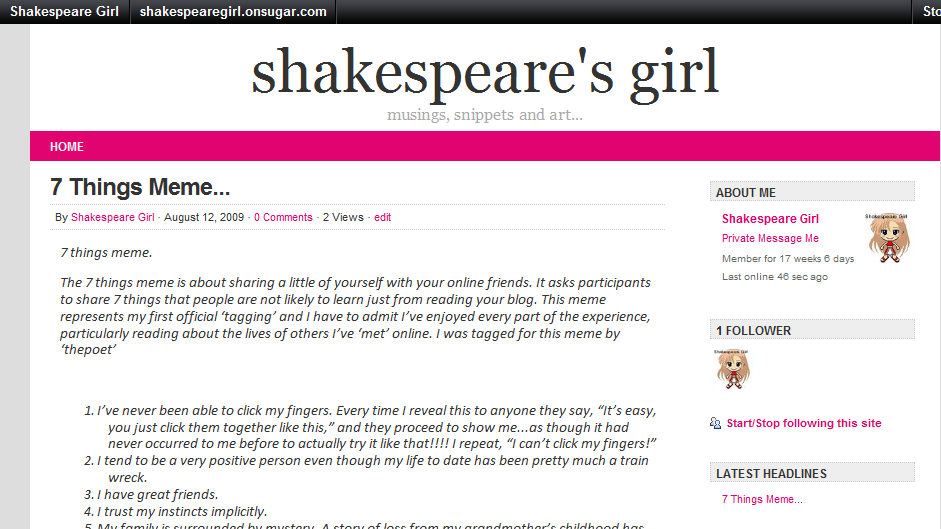
However, I decided to experiment with this idea on my own.  My ‘un-novel’ begins with a blog post and a central character with no idea what she has just revealed about herself and her family…let me know what you think.  Can you guess what happens?  Can you guess this girl’s name?  Are you intrigued…or just bored by the whole idea?

Check out the Shakespeare’s Girl shakespearegirlblogblog:

Why is it that so many students seem to have lost the desire to play with words and language?  I used to love English lessons based around word games and language puzzles.  It was fun for me.  Unfortunately, it seems to be a different story today…often such activities are viewed as tedious, boring or ‘too hard’.

In an attempt to ignite my students’ passion for words I explored the internet to find a few ‘learning gems’…

Wordsense: one of the best around in my humble opinion.

Wordsense

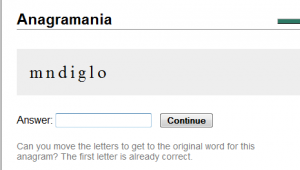
Anagramania: Guess the anagram before the time runs out!

Anagramania

Crickler Crossword: A new type of word puzzle!

Crickler Puzzle

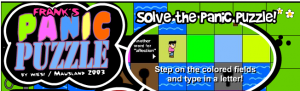
Frank’s Panic Puzzle:

Frank\'s panic puzzle

Word puzzles available from Addicting Games:

Addicting Games

Vocab Sushi: Building a better vocabulary

Vocab sushi

Messing with ideas and words: Plinky prompts
Plinky writing prompts

It also occurred to me that students might find it fun to create their own word games using classtools:

Classtools.net

At my current school we have a regular assembly for the senior school once a fortnight.  Fortunately, I had a few Web 2.0 tools to help my home group complete the half hour presentation.  Thank you Animoto and Google maps for making this job a little easier.  We used the idea of Harmony Day as the impetus for a Google map showing the class’s ancestral links.  Animoto provided not one but three presentations!  The Harmony Day clip: ‘Living in Harmony‘ is below:

My Web 2.0 journey began exactly a year ago, inspired by a few questions at a professional development activity and fuelled by my own desire to understand ‘what all the fuss was about.’

As a way of celebrating this milestone I thought I’d revisit the key discoveries of the past year.  My journey was an informal one, with many paths and many lingering visits along the way.  This blog was my starting point.

Blogging:
One of the first things I did after starting this blog was to explore the amazing array of quality blogs out there.  Many inspired me to develop and maintain the best quality blog I could with my limited talent and experience.

CogDogBlog by Alan Levine proved an excellent starting point.  From there I found the wiki and a list of story tools which fuelled my journey for weeks. I used many of them in my early blog entries and still love the simplicity of tools such as toondoo, slideshare and animoto.

Teacher-Librarian blogs:

As a qualified teacher-librarian I was keen to learn what I could from the online experts in the field.  One of the first gems I found was an Edublogs award winner, A Library by Any Other Name.  I learned about the 23Things Web 2.0 activitiy via this blog and followed it to learn more on my own.

This blog also led to another Edublogs winner, this time a fellow Australian, Judy O’Connell, who maintains the Hey Jude blog.  Judy seems to have an amazing capacity for ‘thinking outside the square’ and has steered me in the direction of many new online connections and blogs, including Dean Shareski’s blog and, one of my all time favourites: Larry Ferlazzo’s Websites of the Day.

The PLN:

The blogosphere is the sort of place where each new connection leads somewhere else: Twitter, Plurk, Ning, Diigo groups, Second Life etc.  It got to the point where I was signing up for something new each day.  It was several months before I realised I actually had a PLN of my own, a discovery which immediately led to a blog post…an event which in itself demonstrated how completely I had become immersed in the Web 2.0 world.  Something had happened…suddenly I needed to share my discoveries with other educators, suddenly I felt responsible for helping others learn.  More importantly, I began to see the real potential of the connections I’d made and began to change the way I approached my job and my teaching.

The Shape of Learning: One Size Does Not Fit All

The best part of my learning journey is the way I have been able to shape it with my own interests and needs.  Surely, this is the most effective type of learning?  The blogs I turn to have changed, the tools I race to sign up for are slightly different from last year’s offerings.  My new best tools include:

pageflakes, which I used to build an Earth 2.0 webquest;

wetpaint wikis which I use to host a wiki for my Year 11 English students called English @ 11. While they are still getting their heads around this new tool they are also learning a lot.

I’ve also rediscovered the potential of flickr, particularly photographs usable via creative commons licensing.  Other tools which complement flickr are available via Big Huge Labs

My new favourite blogs are

The English Blog: for its cutting edge articles and tools

The Best Article Every Day: for fun and great resources

Free Technology for Teachers: for its outstanding resources

Jane’s e-learning pick of the Day: excellent tools

A Geeky Mother’s Blog: excellent writing, great discussion

The Open Classroom: because I’ve met Jo and love to read her thoughts

and ICT in my Classroom: for ICT ideas and activities in a real classroom.


Thanks to Elizabeth Koh who tagged me for this meme which was started by TJ:

“List FIVE changes you would like to see in the educational system. Your responses should represent your perspective and your passion for learning and students…tag the following people…from a variety of perspectives. If you have been tagged, tag as many people as you choose, but try for a variety.”

Real life learning is about passionate engagement and lifelong curiosity. I would like to see the education system change to reflect this.  Students need to be provided with more opportunities to explore personal passions and learn about the things that are important to them.  They need to learn that learning itself is actually fun!

Avoid ‘Ivory tower’ type decision-making by ensuring decisions which impact on schools are based on what’s actually happening in schools.  It is too easy to make far-reaching decisions in an office far removed from an actual student, teacher or class.  Administrators and Principals need to understand what is happening out there.  Educational vision needs to be shared.

Increase funding to libraries and work to raise the status of libraries and teacher-librarians.  Libraries are central to learning and can have a huge impact on student learning outcomes in any school area.  The research to support this is overwhelming yet so many people still don’t get it…

Encourage teachers to work together, share resources and ideas, and give them time to talk to each other.  If we work together we will, ultimately, save time and energy to the benefit of our students and families.  We will also be working towards improving the status of teachers and teaching.   Education-based PLN’s are global and achieving wonderful things daily.

Measure real student achievement through authentic assessment and decrease the status of exams as an indicator of achievement.  Students are so much more than their exam grades!

I would like to tag the following people:

@jomcleay

@alihall

@Hershey Thorp

@LauraMaria

@tabor330

However, I would also encourage anyone with an opinion on this important issue to share their viewpoint

This meme represents my first official ‘tagging’ and I have to admit I’ve enjoyed every aspect of it, particularly reading about others in my PLN.  Thanks to Anne and Ali Hall for tagging me

My 7 things:
My life has been without major drama or loss and I appreciate that I am one of the lucky ones.  However, a story of loss from my mother’s childhood has always intrigued me … her father, Byron Gould, disappeared without a trace when she was 2.  He was on a business trip to Sydney.  My Grandmother looked for him for some time but there was never any trace of him anywhere.  Mum knows very little about him except that he received cheques from America regularly and he always wore a safari suit.  He was American and may have been Jewish.  She thinks his father was a surgeon.  According to an aunt he was devoted to my grandmother.  I must admit I’ve always wondered if he had ‘another life’ somewhere in the United States and perhaps my mother has several elderly siblings…(Mum’s 78 and still going strong)

I’ve never been able to click my fingers and every time I reveal this to anyone they say, “It’s easy, you just click them together like this,” and they proceed to show me…as though it had never occurred to me before to actually try it like that.   I repeat, “I can’t click my fingers!”

It always surprises people when I tell them my sister is a trained medium.  They invariably say, “You don’t look the type.”   I’m still not sure what ‘type’ you have to be to have a trained medium as a sister!

I’ve always suffered from insomnia.  I get some of my best ideas at 2:00am in the morning.  As a memory trigger for the next morning I throw things from my bedside table onto the floor.  I once wrote a short play in the middle of the night.

I am a visual person who is greatly influenced by colours.  I particularly love pink, blue and red.  I organise my files by colour.  (If it’s yellow you know I’m not that keen on the topic or contents!)  When people are wearing different colours I always notice.  It is so obvious that students have commented on it in the past.  When I was going through my ‘pink’ phase my students described me as the teacher who wears something pink every day!  (That’s when I tried to incorporate red…so now I’m in a red phase!)

I tend to be a very positive person although I wouldn’t necessarily call myself an optimist.  I also tend to be lucky and often wonder if there is a connection.  I have also suffered from depression so I understand both ends of the scale.

I am a middle child and believe this has made me a perpetual ‘peace maker’.  I never take sides and always see other people’s point of view.  I’ve come to realise that this can be both a good and a bad thing (What a surprise!).  It also annoys a lot of people.

I think almost everyone in my PLN has been tagged already for this meme.  However, I would like to tag Mari Hobkirk, Grace Kat, Heidi Pence and Inpi.  (If you have already been tagged please pass it on!)

Games are fun.  Learning is supposed to be fun at least some of the time. (If not all of the time…but that’s another blog post)  For me the combination of games and learning is a natural one; they are the perfect complement for each other and a ‘tool’ educators need to exploit more often.

Last year I used a lot of games to attract students to my library.  The plan was a huge hit (which also increased reading and borrowing) and I learned which games worked and which ones didn’t.  We had board games as well as online games which were accessible via our moodle site. Throughout my PLJ (Personal Learning Journey) I have also made a point of bookmarking games I thought might be of use and it occurred to me that others might find my list useful.  The most successful and popular games are listed below

Highlights

Bloxorz is a strategy game that involves manoeuvring a block through a hole with increasing degrees of difficulty.  It proved a huge hit with the boys in my library who spent many lunchtimes working together to solve the problem.  Of course, they were just having fun and unaware that they were also working collaboratively and developing communication and problem-solving skills.

A similar type of game is planarity.  I only just discovered planarity via a recent plurk but I believe it would sit nicely next to bloxorz and prove a similar hit…perhaps I will add it to the list when I return to work!

After the success of bloxorz Students began researching and suggesting other games they considered ‘worthy’ of our library moodle page and I added those I thought suitable:

Jelly Blocks involves similar thinking skills and was the next game adopted after students had mastered bloxorz.

3D Logic was another student recommendation.  It begins with something that looks a lot like a rubik’s cube and also involves strategy and problem-solving skills.

Mansion Impossible is quite different from the puzzle-type games that proved popular with students.  It requires participants to buy and sell houses to earn enough money to build a 10 million pound mansion.  The students loved it but seemed to find it too easy.

I also added a few keyboarding games such as  The Keyboard Game and Key Master.

Educational Games

The obvious ‘educational’ games proved less popular with students when they had ‘free time’ but were, nevertheless, useful additions to our list of games and would attract occasional interest.  Of course, students would love to be allowed to play these games during class time but they wanted a different type of challenge during their ‘free time’ in the library.

Questionaut One of the BBCs bitesize games An excellent model for educational games.  This one is designed for revision.

Purpose Games A wide selection of trivia and quiz games with purpose.

Gut Instinct Another BBC game.  Great for revision.

Puzzle Choice A good selection of puzzles including mazes, word games etc and some excellent links to other online games including Wordsense which is one of our family’s favourites.  My 16 year old son loves this one and he usually goes out of his way to avoid anything educational.

The Magic Factory attracted a lot of attention from the younger students, as did the games available via The Stacks at Scholastic.

My ‘Library Legends’ (aka library monitors) loved playing Immune Attack on my laptop, a great game that  “introduces basic concepts of human immunology“  However,  I believe the ’shoot ‘em up’ aspects of this game were the real attraction.

A group of games from the Nobel Prize organisation is also worth a look.  These games include are designed to teach us about the Nobel Prize award and include simulations and games based around the Nobel Prize in Physics, Literature, Chemistry, Peace, Medicine and Economics.

I hope you enjoy exploring these games.

Games are Learning Gems

“Not another wiki” was a comment I heard recently while listening to a group of inspiring educators on Plurk Radio.  It was delivered in a tone which suggested this person had ‘done’ wikis ‘to death’ and was ready to move on.  It brought home to me the diverse range of skill, understanding and experience ‘out there’ amongst educators.

My reality is quite different.  Most of my colleagues have never created a wiki.  I’m sure there are many other teachers out there who don’t really have an understanding of wikis beyond wikipedia and have never really thought about classroom applications because they don’t really ‘get it.’

The power of the wiki

I think wikis have huge potential in the classroom.  They are fantastic tools for sharing information and building knowledge.  They are also versatile presentation vehicles.  Indeed,  the list of things I have learned from my current wiki experiment grows daily and highlights the learning possibilities for students.

What I have learned…(so far)

  • How to embed a webpage into a wiki:  Thanks to the Getting Tricky With Wikis wiki!  This makes web pages more accessible and user-friendly, both important considerations for students.
  • How to access and use databases such as Press Display to facilitate students’ learning.  Many large local libraries probably subscribe to this database.  Mine does (CCLC) but you have to be a member to access it.  I used this to add a newspaper article, including tasks, to my wiki.
  • How to use Glogster to build the Useful Online Resources page in my wiki.  This provided a vibrant, visually appealling vehicle to highlight learning tools available to students.  (I can’t draw so this sort of creativity is really important to me.)
  • Read Write Think provides an excellent array of graphic organizers.
  • Internet Archive is an excellent resource for educators.  I found some useful public domain audio books here and added them to my wiki so that students can access them for our theme study, ‘Future Worlds’
  • The State Library of Victoria’s, Ergo site is an amazing resource that is going to prove very useful over the years.  A visit to the essay writing skills page is a must for teachers and students everywhere.
  • How to embed an audio file into a wiki:  This proved to be the trickiest!  Thanks to a twitterer I discovered Divshare and worked out how to do the embedding myself (with a little help from an edublogger post, of course!).

Now, that’s a lot of learning for one little wiki!  Hopefully, my students will gain as much from their own wiki experience in the 2009 school year.

I would love to hear from others with positive wiki experiences.  Please share a link.

Useful Online Resources using Glogster

I am a definite fan of microblogging.  It has something to do with the quick, sharp repartee that is so like a real school staffroom it is kind of weird.  Teachers rarely get a chance to have long meaningful chats with their professional colleagues during school hours.  There is never enough time! Instead we have the corridor ‘catch up’, often while walking in opposite directions, or quick conversation snippets shared in between meetings, phone calls, classes, conferences etc.  When we need to talk to someone we almost always have to do it quickly and, consequently, by getting straight to the point.  Is it any wonder microblogging just seems like natural communication to me?

Plurk

Plurk has become one of the first places I check when I turn on my computer.  It feels like I’m catching up with colleagues.  The fact that many of them live in another hemisphere is not important.  We are all educators and we are all concerned for our students and eager to learn anything that might improve the way we teach and learn.  We share Important and irrelevant details, wish each other goodnight and good morning (sometimes), moan about day-to-day ‘teacher-type’ problems and learn together about things that are new and/or useful.

Plurkers

I look forward to hearing about the weather in Brattleboro VT USA, not because I care about weather particularly but because it means Skip Z is out and about and his morning ’shout out’ is a Plurkadian tradition.  He’s also a professional colleague whose opinion I value and many of the links he has shared on Plurk have become an important part of my teaching and learning.   Mindelei is another plurker guaranteed to challenge my thinking.  Her passion and enthusiasm are a plurk feature and she loves to ask questions to make ’seasoned’ educators think.  GingerTPLC is another plurker of note.  Her teaching day is a constant reminder of what we are all trying to achieve in our classrooms.   Kevinh has energy in abundance and is clearly a well respected educator.  I don’t really have a spatial understanding of North America but Kevinh seems to be presenting in most of it!

I could go on…

If I listed all the Plurkers I value it would take far too long and I simply don’t have the time.  Could I just leave you all with this one piece of advice:  If you’re an educator sign up for Plurk. The Plurk ‘eduverse’ is a wonderful place and you’re guaranteed a welcome!

Next Page »